
Contents · 13 chapters
- 01“At last!” How Germany greeted the coup
- 02The pretext: what Bonn knew, and what it chose to believe
- 03“A cleansing entirely in our interest”
- 04Propaganda made in Germany
- 05“Action Programme Indonesia”: against communism, for the army
- 06Annihilating the communists: an argument for support
- 07The German state as arms dealer
- 08The killing as a sales argument
- 09The Bundeswehr, the BND and the killers
- 10“Blood, bodies, legs, heads”
- 11What Germany knew
- 12Nazis for Jakarta
- 13“Shoulder to shoulder”: Bonn, Washington and the winners
- —Testimonies
- —The files
- —Sources
- —Contact
In 2014 the German government told parliament it had no precise information on how many people were killed in Indonesia in 1965 and 1966. Its own archives say otherwise: by February 1966 they already counted almost 800,000 dead. And they speak plainly, word for word: an official in Bonn greeting the news of the coup with “ENFIN!”, at last; the Foreign Office recording that the Indonesian armed forces were “systematically annihilating the Communist Party”; and, for the arms that followed, “keine Bedenken”, no objection. The story is more than sixty years old, and it leads from a Berlin archive to Palestine, where in September 2025 a UN commission of inquiry found that Israel is committing genocide in Gaza. Again with German support. When Berlin is criticised for backing Israel’s war crimes against the Palestinians, its answer is almost always the same two words: “historical responsibility”. But it was the absence of exactly that responsibility that let West Germany, only twenty years after the Holocaust, become part of another genocide.
The Indonesian army took the country on 1 October 1965. On the night of 30 September, a group of officers calling itself the 30 September Movement, led by Lieutenant Colonel Untung of the presidential guard, kidnapped and killed six generals of the army high command. Within hours Major General Suharto, commander of the army’s strategic reserve, Kostrad, had crushed the movement; within days the army was blaming the Communist Party for all of it. Suharto (1921–2008) took command, and the president of the day, Sukarno (1901–1970), never saw it coming. Sukarno kept his title. He kept nothing else, and in March 1967 they took that from him too. Within weeks the army began banning the Communist Party of Indonesia, the PKI, province by province; in March 1966 it was banned nationwide. It was then the third-largest communist party in the world. Every organisation connected to it was banned in its wake.
By 1965 the PKI had up to three and a half million members, and through its trade unions, its peasants’ front, its women’s and its youth organisations it reached some twenty million more, one Indonesian in five. In 1955, in the only free elections the country would see for more than forty years, it had won 16 per cent of the vote. Its peasants’ front, the BTI, was occupying the landlords’ fields to force through a land reform that had been law since 1960 and had barely been carried out. The party wanted the foreign oil companies and plantations out, and it stood against the British in Malaysia and the Americans in Vietnam. That is what made it the enemy, in Jakarta, in Washington and in Bonn.1
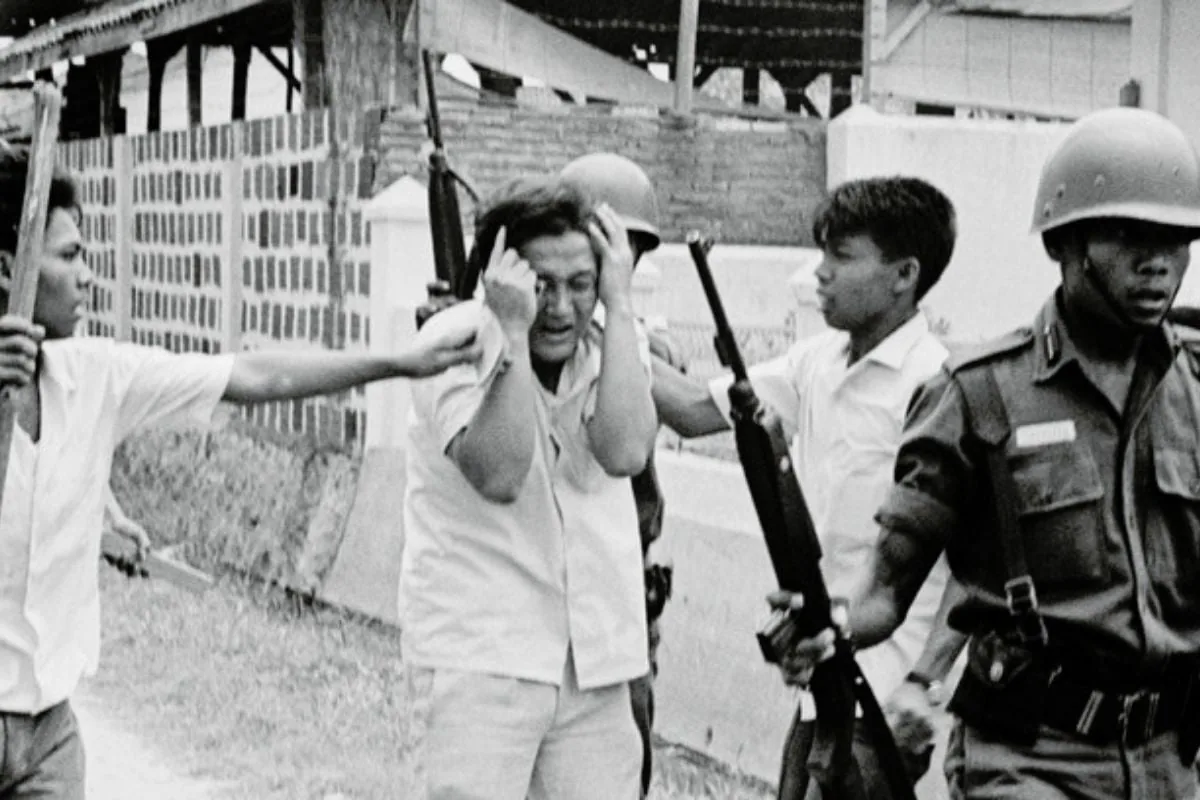
What followed ran from October 1965 into the early 1970s. Leaders, members and sympathisers went into the camps, and from the camps into the ground. Survivors we filmed for our documentary told us of mass graves, beheadings and rivers full of corpses. Sarwo Edhie (1925–1989), who commanded the army’s RPKAD para-commandos, later put the number executed at “two or three million”.2 This is a genocide, and it was committed against communists. Outside Indonesia almost nobody knows that it happened.
In July 2016 the International People’s Tribunal on 1965 in The Hague, a tribunal of judges and jurists without the power to punish, concluded that the killings by the army and the militias it trained and supported were genocide, the partial destruction of a national group, and it named the United States, Britain and Australia as complicit. Four years earlier Indonesia’s National Human Rights Commission had found crimes against humanity and spoke of a state policy to exterminate the members and sympathisers of the PKI. Asked in 2014 whether the massacres were crimes against humanity, the German government recalled that the offence had been known since the Nuremberg and Tokyo trials and saw “no current reason” to examine whether it applied to events almost half a century old. Asked in 2023 whether they were genocide, it replied that it was not for it to anticipate the reckoning of scholars, civil society, international bodies and, above all, Indonesia itself.3
The evidence for that reckoning has long been sitting in the government’s own archive. This article rests on the files themselves: telexes, reports, memos and minutes from the Political Archive of the Federal Foreign Office in Berlin, together with papers from the Federal Archives in Koblenz and from Washington. They show what Bonn knew about the killing, and when. And they show what it did with that knowledge: it welcomed the coup, spread the army’s propaganda, held out money to the army’s side and cleared weapons for it. The money is on file too. Before the coup Bonn guaranteed credits that, in its ambassador’s words, would also “strengthen the circles well disposed towards us (such as the army, among others)”; while the party was being smashed, the BND, by its own chief’s later account, gave “advisers, equipment, money”; once the killing was done came debt rescheduling, new credits and capital aid, DM 100 million of it by 1969.
“At last!” How Germany greeted the coup
The files of the Political Archive of the Federal Foreign Office have even preserved one of Bonn’s first reactions to the coup. Bonn was the capital of West Germany until reunification in 1990, when Berlin became the capital again. On 4 October 1965, the embassy in Jakarta sent an encrypted telex marked “citissime” to the Foreign Office for the Federal Minister of Defence. The “left-oriented coup attempt” had failed, it reported; Sukarno and General Nasution, the coordinating minister for defence and security, who had escaped the kidnappers, were in control with government troops; six generals had been kidnapped by the rebels, and according to an as yet unconfirmed report General Pandjaitan had been shot resisting and the others murdered afterwards. The message was signed by the military attaché, Meyer. Beside his name, an official in Bonn wrote a single word by hand, in French: “ENFIN!” In English: at last. What had come at last was not the death of six officers. It was the opening against the communists, and the man in Bonn had been waiting for it.4
This reaction did not come out of nowhere. Bonn had been shown a trial run months before. On 8 January 1965 the attaché Meyer wrote to the Defence Ministry in Bonn, in the tone of a man passing on office gossip, about Major General Ibrahim Adjie, the army commander in West Java. A few weeks earlier, he noted, Adjie had had about 1,400 communist plantation workers arrested “as a precaution and on a trial basis”, to see how the Communist Party would react. The party did not react. According to rumours, Meyer went on, 400 of them could therefore be let go. “The rest were buried.”5 Bonn took note, and said nothing.
Two months later Bonn was told what the army was being kept for. On 8 March 1965 Luitpold Werz, West Germany’s ambassador in Jakarta, sent home a six-page report on the armed forces in the struggle inside the country, and it ends with a conclusion: the army and the navy had come through intact “as a reservoir of force for a later open confrontation with the communists”. Nobody in Bonn asked what such a confrontation would cost. The report went up to the Minister. The State Secretary, the highest civil servant in the ministry below the minister, wrote in the margin: “A very instructive report.” To judge by the initials, it was Karl Carstens, who had served in the SA as a student, had joined the Nazi party and would later become Federal President. Werz was to be told that it had met with great interest and was regarded as accurate.6
By the summer the officers were saying it openly. On 18 June 1965, three and a half months before the coup, the German military attaché in Jakarta reported that the PKI had so far not made the mistake of acting outside the law, and that senior Indonesian officers had often told him the armed forces were “only waiting for this moment, to be able to strike”.7
When the moment came, the Germans found the army too slow. On 5 October the embassy’s written report on the putsch complained that in the first days of October the army, “instead of using the opportunity for an annihilating blow against the communists”, had decided on strict legality, and, it seemed, had let “its historic hour” go by.8 Two days later, on 7 October, the same attaché complained in a cable to the Defence Ministry that the armed forces had “so far not exploited the opportunity to strike against the PKI”.9
The pretext: what Bonn knew, and what it chose to believe
The entire justification for the extermination was the claim that the PKI had organised the coup. In the first weeks the German files do not believe it, and say so in writing. Then, once the killing was well under way, they change their minds, and the file shows what changed them.
In its analysis of the putsch, written in early October 1965, the embassy concluded: “One can therefore assume that the putsch was inspired and supported by the communists. Directed it, however, they probably did not; its execution was too amateurish for that.” Of Untung, the officer who fronted the coup, the same report says there is no indication that he was a supporter of the communists. The same page records what a senior Indonesian officer had told an embassy staffer: the army leadership was “completely clear” that the putsch of the 30 September Movement was “in reality a showdown between the army and the communists”.10 A few weeks later, the embassy noted that the “communist uprising” of 1 October had been put down by the army “narrowly and relatively bloodlessly”.11 The blood came afterwards, and it was not shed in battle.
The embassy also understood exactly how the pretext worked. Its key report of 18 October 1965 states that the army leadership had used Sukarno’s mandate to restore order for a “thorough action” aimed at removing the communists step by step from all positions in state and society. The army, the report goes on, reads the mandate as an order to “liquidate” the 30 September Movement, the “Gestapu”, “and its backers and sympathisers”. Then it spells out the method in one sentence: “By identifying the PKI with the Gestapu, the army preserves the appearance of legality for its anti-communist reform programme.”12 Gestapu was the acronym the army’s propagandists invented for the 30 September Movement, chosen because it sounded like the Gestapo. Further on, the same report observes that the intensified wave of arrests “obviously no longer has anything to do with the putsch” and is aimed at smashing the cadres of the communist sub-organisations.13 A week earlier, on 11 October, the embassy had already described how it was done. Without formally breaking with Sukarno, it reported, the army had “staged a popular movement against the communists” under the protection of the state of emergency it had declared itself, while the media it controlled hammered the crimes of the communists into the people, the murder of the generals “in all its gruesome detail”. Muslim leaflets, the report went on, were calling for “djihad, the holy war against the atheist communists”, and the embassy enclosed two of them. One, handed out in Jakarta on 8 October, the day young Muslims burned down the PKI headquarters, closes its list of demands: “Assist the Armed Forces eradicate wholly the executors of the 30 September Movement.” The other sends “holy-war greetings” and says: “Let us jointly destruct the atheists until their very roots.” So the German embassy knew in the second week that the “people’s anger” was being organised by the army.14
Nor could anyone in Bonn claim that the PKI was fighting back. The embassy’s November summary of the coup records the communists’ restraint after the failed putsch and judges it probable that “the systematic decimation of the top communist cadres by the army at present rules out the coordination of communist actions on any wider scale”.15 The victims were not resisting; they were being decimated according to plan. The Federal Government knew that the coup was the pretext, that the killing was overwhelmingly one-sided, and that the party being annihilated was largely defenceless. It supported the annihilation anyway.
Then the embassy changed its mind, and it did so in the very report that recorded the decimation. On 15 November 1965 it headed its summary “Communist coup attempt in Indonesia” and took back its October reading in so many words: Untung’s rapid failure had “seemed to point to an amateurishly led military coup and to rule out active direction by the communists”; now, “after captured communist documents and statements by military putsch leaders became known”, the “outlines of a gigantic communist coup undertaking” were emerging. The statements came out of the army’s interrogation rooms. The embassy attached an extract from the interrogation of Untung, received “from a special source”. The interrogator tells him that someone must have been behind it: “Who directed the undertaking from the background?” Untung: “Behind me stood the PKI.” One question, the embassy wrote, still remained unanswered: how a “communist uprising” prepared “carefully and long in advance” could have failed so spectacularly. On 6 December it went all the way. Forwarding the translated protocol of the interrogation of the Politburo member Njono, likewise obtained “from a special source”, it wrote: “The following conclusions can be drawn from the protocol: 1. The PKI leadership planned and organised the coup attempt of the ‘30 September Movement’.” Nine weeks on, the embassy had adopted the army’s account. It had not taken much. The Njono protocol sealed it: a confession obtained by the men doing the killing from one of their prisoners. The protocol has Njono being asked whether he is acting under any compulsion or pressure; he says he is not. Such protocols usually do.16
“A cleansing entirely in our interest”
What the German embassy was doing in those weeks is on record in the files of both Bonn and Washington. Ambassador Werz himself was away. From 6 October he was in Hong Kong and only got back to Jakarta on 14 October; beside the telex announcing his arrival an official in Bonn wrote: “About time!” On 12 October 1965, in a telegram marked secret to the US Secretary of State, Dean Rusk, the American ambassador in Jakarta, Marshall Green, reported that an officer of the German embassy had passed on that the “Indo Army is now considering possibility of overthrowing Sukarno himself and is approaching several Western Embassies to let them know that such a move is possible.”17 The German embassy was one of the Western missions the Indonesian army kept informed while it weighed removing the president. The document is not in the German files. It is in the American ones, declassified in 2017.
Five days after his return, in two telegrams marked secret, Werz described the machine he had found at work. The army was pressing on “resolutely with its programme of step-by-step suppression of the PKI”. Once it had a central power “cleansed of communists”, it apparently meant to move on to “the cleansing of the individual provinces”, and nobody could yet see how the communists might stop “the military steamroller that has started rolling”. And Bonn? Werz’s advice fits in one line: hold back for now and wait to see what comes, “so as not to make the position of our friends in the army more difficult”.18 Unserer freunde in der armee: our friends in the army. That is how the ambassador of the Federal Republic spoke of the men running the extermination.
On 25 October he put it on paper again, this time in a personal letter to the head of the political department in Bonn. There was fear on every side, he wrote, and then: “All the same, I hope that the army, which despite the President’s contrary instruction is systematically clearing out the communists, will prevail, and that better times will then dawn for us.”19
On 26 October 1965, the same day on which the Foreign Office’s Indonesia desk recommended approving the export of pistol grips to the Indonesian army, Alexander Böker, a senior official in the Foreign Office’s political department, wrote to Werz:
“We naturally follow the development there with the greatest interest and are pleased at the progress in the consolidation of the army regime. We are entirely clear about the great opportunities this development holds for the Western world as a whole and for Germany in particular, and the great dangers we would be exposed to if the experiment were to fail.”20
The “experiment” was, at that moment, the mass murder of communists. Werz answered on 8 November 1965, in a letter marked “Personal and Confidential”. What troubled him, he wrote, was that people in Germany apparently wanted to let Indonesian matters rest entirely: Hermes guarantees for smaller amounts, the state’s insurance on export credits, had been stopped and were not being dealt with for the time being, and a trip by an official of the Goethe-Institut, West Germany’s cultural institute abroad, had been called off against his own recommendation. Then:
“It would be very regrettable if, at the very moment in which a cleansing entirely in our interest is taking place here, the army circles who today are largely in charge were to gain the impression that we had written Indonesia off.”21
“Bereinigung” is what a German official writes when an account is settled or a discrepancy cleared up. It is the vocabulary of bookkeeping. Werz used it for the purge that was under way in the country, and he used it as an argument: Bonn should not leave the small Hermes guarantees suspended now.
With tens of thousands dead, and soon hundreds of thousands, the ambassador of the Federal Republic pleaded in the same letter for “business as usual”. Any larger action, or a new credit line, he conceded, should wait until the situation had become clearer and the Indonesians asked for it. Three weeks later, in telegram No. 593 of 29 November 1965, Werz reported that after West Java the military governors of South and South-East Celebes (Sulawesi) and of the Moluccas had now also ordered the definitive dissolution of the PKI, and he added a calculation: “possibly this procedure is not at all unwelcome to Sukarno at the moment, since it relieves him of the promised, unpleasant ‘political final solution’ and he can distance himself from these military measures later”.22
The phrase in quotation marks is not Werz’s coinage. It was the embassy’s German for the political settlement of the 30 September affair that Sukarno had promised, and that settlement meant the disposal of a political party. More than twenty years after the word had acquired the meaning it has in German, the diplomats of the Federal Republic used “Endlösung” three times in six weeks, on 15 November, 29 November and 23 December, each time over Werz’s name, in quotation marks and without a word of comment.
Propaganda made in Germany
The Federal Republic did not confine itself to watching. On 15 October 1965, two weeks after the coup, Hilmar Bassler, senior counsellor in the Foreign Office and head of the desk responsible for Indonesia, recorded in a memo classified confidential that two state media institutions had been asked to join the campaign:
“The BPA and Deutsche Welle were asked, immediately after the outbreak of the revolt, to give special prominence to the communist tactics and the bestial murder of the Indonesian generals as proof of the communist approach to seizing power.”23
The BPA is the Bundespresseamt, the Federal Press Office, which answers directly to the Chancellor. Deutsche Welle is the Federal Republic’s state foreign broadcaster, and it broadcast to Indonesia. Both were “asked”, within days of the coup, to push the story of communist guilt into the world. Bassler was not satisfied even with that. “In my view,” his memo continues, “the approach of the communists has not been given sufficient attention in the German press. In particular, large newspapers such as the ‘Züricher’ should also be prompted to occupy themselves with this theme.” The “Züricher” is presumably the Neue Zürcher Zeitung.
Through the embassy’s telex channel, Bonn received the reports of the correspondent of dpa, West Germany’s main news agency, on the army’s propaganda: a television film showing “the recovery of the horribly mutilated corpses of the army generals”, broadcast several times; and the report that the communist youth organisation Pemuda Rakjat and the women’s organisation Gerwani “appear to have been involved” in the murder of the wife and children of a regimental commander loyal to the government.24 The atrocity tales fed the pogroms. Bassler’s memo records that the BPA and Deutsche Welle had been asked to put out exactly this narrative of the PKI as the bestial slayer of the generals, even though the Foreign Office’s own embassy had written that the PKI, though it had inspired and supported the putsch, had probably not directed it. By the time the killing reached its height, Bonn had already asked its state media to spread the army’s story.
Even the channel was no accident. The dpa office in Jakarta had been opened “at the express and urgent wish of the Foreign Office”, the Foreign Office’s press desk noted on 6 October 1965, to counter the East German and the communist news agencies.25 And the embassy knew what kind of story it was helping along. On 22 November it wrote to Bonn that the murder of the six generals had been “skilfully played up for propaganda by the army”, that it had turned the people against the communists and brought the army and the Muslims together in one front, and that in this lay “a tremendous opportunity for the army”.26 Five weeks later, on 30 December, Werz sent a telegram that was also addressed to the Federal Press Office. The army daily, Harian Angkatan Bersendjata, had asked for material on a new German book about Sukarno, and he proposed that the “Dienst aus Deutschland” send the embassy an exclusive feature with photographs as soon as possible.27 Bonn was not only repeating the army’s propaganda. It was offering the army’s newspaper its own copy.
“Action Programme Indonesia”: against communism, for the army
The line Bonn followed in the autumn of 1965 had been drawn a year earlier. None of what follows was commerce alone. Twenty years after the Second World War the credits and the weapons carried a political purpose, and the Foreign Office wrote that purpose down. On 22 December 1964 Alexander Böker, a senior official in the Foreign Office’s political department, chaired an in-house meeting in Bonn under the heading “Action Programme Indonesia”, with Ambassador Werz and ten desks present. The minute, taken down on 7 January 1965, sets out his argument in reported speech. Indonesia, he said, was regarded as a barrier or a springboard for communism on its way to Australia. The national interest in maintaining a German presence there required sacrifices of a financial nature, to which, however, limits were set. Indonesia was a decisive test case. At the same meeting Werz reported what he had told the Indonesian deputy foreign minister would follow if the East German consulate-general were raised to an embassy: the rupture of diplomatic relations and the end of economic aid.28 This was the Hallstein Doctrine: from 1955 Bonn threatened to break off relations with any state that recognised the GDR, the German Democratic Republic, and it had done so with Yugoslavia in 1957 and with Cuba in 1963. Why that mattered so much, the historian Baskara T. Wardaya of Sanata Dharma University in Yogyakarta explains in a few words: “If you remember the history, there were two Germanys: West Germany and East Germany. West Germany was very capitalistic and pro-America. So they didn’t like Sukarno, and they didn’t like the PKI.”29
The minute is franker still where it records who said what. Asked by Böker whether substantial aid would keep Sukarno from recognising East Germany, Werz replied that Sukarno’s authority held for now, and added: “If we keep helping, we also strengthen the circles well disposed towards us (such as the army, among others)”. Bassler remarked that “the dry stretch until a new regime in Indonesia after Sukarno’s demise” had to be endured.30 At the second session, on 11 January 1965, Böker set the line for everything that followed: German policy was “to be directed towards the final phase of the Sukarno regime”, and Werz and the Indonesia desk agreed that this phase had begun.31 Nine months before the coup, Bonn had put its money on the army and was content to wait for Sukarno’s downfall.
Two years later the Foreign Office conceded as much, in a memo never meant to leave the building. In February 1967 the Indian magazine Link printed what it presented as a secret report of the German embassy. The Foreign Office decided it was a forgery, and in the same memo conceded that it described “exactly our position at the time”: the embassy and the Foreign Office had indeed put plans for further aid on hold “in view of the ending Sukarno era”. Böker advised against a denial. A denial would be turned against Bonn at once, because as long as Sukarno was still formally head of state, Bonn could not declare that it had held back its aid in view of his “ending regime”.32
Annihilating the communists: an argument for support
The files in the Political Archive of the Federal Foreign Office show that Bonn was in the picture from the first week, and that its policy ran in step with Washington’s.33 The Foreign Office in Bonn knew that “the Indonesian armed forces are systematically annihilating the Communist Party”, as the senior counsellor Hilmar Bassler recorded on 3 December 1965. He wrote it down not as a protest but as an argument for exporting three customs boats to the regime. Because the armed forces were “systematically annihilating” the party and had already put out feelers to Malaysia, the tension between Indonesia and Malaysia could be expected to ease “in the course of the political changes in Indonesia”. The boats, he added, were unarmed and meant for fighting smuggling. His desk had found the deal legally permissible and “politically defensible towards Great Britain” on 30 September, the day before the putsch. What the killing added was the political argument, and he closed: the deal “should therefore be approved”.34 Seven months earlier the same boats had been kept out of the aid package. At an interministerial meeting on 13 May 1965 all sides agreed that they should not be included “because of the possibility of military use”, and because they would have taken the package well past its DM 100 million limit.35 Nothing about the boats had changed by December. What had changed was that the army was now killing communists.
The financial support predated the coup. On 14 January 1965, Foreign Minister Gerhard Schröder, the Christian Democrat, not the later Social Democratic chancellor, wrote to the Federal Minister of Economics, Kurt Schmücker, to push for a DM 100 million special ceiling on federal export guarantees for Indonesia. He did so “on purely political considerations”, dismissing any economic qualms: continued economic cooperation was, he wrote, “perhaps the only means still available to us” to hold Sukarno back on the German question, above all from recognising the GDR.36
An internal note of the Economics Ministry from 17 March 1965 recalls that the cabinet had approved the ceiling eight weeks earlier “under the threat of admitting a Soviet-zone consulate-general”. “Soviet zone” was Bonn’s name for the GDR, which it refused to recognise as a state. In December 1964 Bonn’s guarantee exposure to Indonesia was some DM 500 million and the country was devoting 40 to 45 per cent of its budget to defence. The Economics Ministry drew its conclusion: “On economic grounds further financial aid to Indonesia cannot be justified.” The Foreign Office backed the next guarantee all the same.37
Once the coup was over, the financial lever was turned on the new masters. In November the Foreign Office prepared a briefing for the Minister’s talks with Achmad Sukendro, a brigadier general and state minister whom the ministry regarded as one of the army’s sharpest political thinkers. Under “the most recent political development in Indonesia” the paper opens with one line: “The army has largely smashed the communist party in recent weeks.” The Foreign Office intended to press for an increase in federal export guarantees for Indonesia “as soon as a normalisation of conditions in Indonesia begins to appear”.
Then the paper tells the Minister what to say: that the Federal Government has followed developments in Indonesia in recent weeks with the greatest attention, and that “it hopes the armed forces will succeed, with their vigorous measures against the putschists of 30 September, in restoring calm and order throughout the country”.38 The vigorous measures were the ones the same ministry was writing down in its files, week by week. State Secretary Karl Carstens received Sukendro on 26 November 1965 and reported it to Jakarta the next day in a classified telegram. Then came the sentence that matters: “We would nevertheless do what is in our power to support Indonesia in view of the present direction of its political development.” Sukendro, for his part, said that the army leadership had known as early as the beginning of September of plans to murder eight generals, but had regarded the information as a provocation and not taken it seriously. The tragic death of the six generals, his close friends, had given the non-communist forces “the opportunity to act”.39 What the “present direction” of Indonesian politics was in November 1965, the reader already knows. A “capital aid agreement” followed in May 1968.40
Bonn’s money went to the army’s side before, during and after the killing, in different forms. Before the coup it came as credit guarantees and loans which, as Werz put it, would also “strengthen the circles well disposed towards us (such as the army, among others)”. During the killing Bonn made no new commitments of public money; it tied them instead to the killing’s success. On 8 November Werz reported that small Hermes guarantees had been suspended for now. On 10 December Werz reported that a senior Indonesian official had asked him for financial help “on behalf of the army”. Werz wanted to know first “where Indonesia was going”. Assured that the anti-communist course would be “consistently continued”, he promised to treat the Indonesian wishes “with friendly goodwill, despite existing budget difficulties”. Six days later Washington cabled that “Japan and Germany are in best position to offer early assistance” and asked its ambassador whether he, his Japanese colleague and Werz could meet informally “to concert on tactics and strategy”. The intelligence service went further. On 8 November 1965 a BND file records the generals’ “urgent request” for DM 1.2 million in cash, “funds which, for obvious reasons, cannot be taken from the Indonesian treasury”, mainly for “special operations against Communist Party functionaries” and for “orchestrated demonstrations”. Such help, the BND noted, could have “barely foreseeable consequences” for giver and recipient alike if it became known. The document bears the handwritten note “rejected, non-interference”; whether any money was paid is not known. In 1968 the new BND chief, Gerhard Wessel, wrote in a draft for the Bundestag’s intelligence committee that the service had given “support (advisers, equipment, money)” to Indonesian intelligence and the army’s special units in “smashing the PKI”, and that Suharto, Nasution and the Sultan credited the BND with “a large share in the success”. Three years later Der Spiegel reported that the BND had supplied Indonesia’s military intelligence in 1965 “with submachine guns, radios and money (total value: 300,000 marks)”, and that a team of BND men had trained Indonesian military intelligence officers in Indonesia itself. No file released so far confirms the details of either report. Once the killing was done, the money flowed openly: debt rescheduling and a DM 50 million credit in 1966, a DM 75 million capital aid agreement in May 1968, DM 100 million of capital aid by 1969, and, in the Foreign Office’s words, “every interest in propping up the present Indonesian government”.41
The German state as arms dealer
The weapons files show that the Federal Republic did not merely license the suppliers of the killers. Through a company it owned, it was one of the suppliers itself.
In a memo of 27 January 1965 on a meeting with Indonesia’s Third Deputy Prime Minister Chairul Saleh, a German official boasts that the Federal Republic’s aid “is not limited to the purely economic sector. For example, the federally-owned company Fritz Werner, Berlin, has concluded supply contracts for Indonesia’s armaments and munitions factories worth around DM 63 million in recent years.”42 Part of the arms business with Jakarta was conducted by the German state itself.
On 26 November 1965, in the middle of the massacres, the Foreign Office minuted that the chairman of Fritz Werner had just been called on by a special envoy from General Nasution, sent to say that the general remained interested in the explosives factory, order value DM 80 million; the plant, the minute adds, was intended for military as well as civilian requirements. Western support in this form, Nasution had the envoy add, was particularly useful and indispensable to the army leadership if it was to achieve independence from the Eastern bloc; a Czech firm was also after the contract.43 By March 1968 the same company had signed a contract with the Indonesian government, represented by the “Minister Commander in Chief of the Indonesian Army”, for the delivery of spare parts and weapons, among them 250 BM 59 rapid-fire rifles, 9,750 breeches and 5,000 barrels. The weapons were to be manufactured and shipped by Pietro Beretta in Brescia, Italy, “on our behalf”, and routed from Brescia via Hamburg to Jakarta.44
The concern to hide the German origin of these goods runs through the file, from 1965 to 1968. On 26 October 1965, while the massacre was well underway, the Foreign Office’s Indonesia desk dropped its objections to the “export of pistol grips” and asked the licensing desk to approve it. Two reasons are given. The order is small. And: “It would be indefensible for us to refuse this indirect aid to the Indonesian army, which is currently proceeding against the Communist Party with armed force.” Then comes the instruction: care should be taken “that the pistol grips carry no marking as a German product”.45 Two weeks later, on 11 November, Bassler’s desk argued the same way about life jackets for the army and the navy. Precisely at this moment, it wrote, applications like this one, which could not be turned into accusations against Bonn, should be used “to demonstrate our openness towards the Indonesian army and navy”.46 In November 1968 the Foreign Office cleared an application by Industriewerke Karlsruhe AG to export 20,000,000 rounds of 7.62 mm ammunition to the Indonesian army, explicitly “without NATO marking”.47
The killing as a sales argument
The argument was ready before Christmas. On 20 December 1965 Dr. Fröwis of Bassler’s desk put a memo on “arms deliveries to Indonesia” to Bassler. The Federal Government, it said, found itself in the extraordinarily difficult position of not even being able to support the Indonesian armed forces, “which have largely smashed the Communist Party” and were about to give the country a new political direction, indirectly, by approving the export of weapons and military equipment. If the West kept up its de facto embargo, the army would have no way out but to turn to Moscow. The ban, Fröwis had already told a British embassy official, might have to be reviewed in the foreseeable future because of the upheaval in Indonesia.48 The smashing of the party was no reason to hold back. It was the reason to deliver.
One document states outright why the business was now to go ahead. On 28 January 1966 the head of Division III of the Foreign Office set down a minute on the export of explosives plants to Indonesia. The industrial group Ferrostaal had asked as early as June 1965, almost four months before the coup, whether it could count on an export licence for “15 complete facilities for the manufacture of explosives”, with a monthly capacity of “almost 2,000 tonnes of explosives, powder and intermediate products, 1,100 km of fuses and 1.1 million detonators”. The works estimated the price of the plant at about DM 40 million. The client, the minute states, is the Indonesian army.
Then comes the first argument for approval, and it is the killing: because the army “has largely prevailed against the communists in Indonesia”, it can be expected that some of the previous foreign policy aims of the government there will no longer be pursued with the same emphasis. The Confrontation with Malaysia, Konfrontasi, Sukarno’s undeclared war against the creation of the Malaysian federation from 1963 to 1966, was the object of those aims. It was the main obstacle to the Indonesian army making use of German explosives; with Britain on hand to defend Malaysia, Bonn had no desire to be seen as arming the opposition. But the Communist Party’s destruction took the edge off that obstacle, and one German official made a note of it as grounds for a sale. The conflict, the minute conceded, was “not yet settled”; but since the order would take at least two to three years to fill, it should be no reason “to sacrifice our interests”.
The rest of the minute follows from it. Refusing the Indonesian army’s orders would mean “weakening those forces which we seek to support, thereby indirectly playing into the hands of the communist elements that still exist”. And meeting its wishes “would substantially strengthen our position precisely among the politically decisive right-wing circles”.49 Whether the plants were ever shipped, the files do not show. On 22 February 1966 Bassler’s desk, pointing to the latest turn in Indonesia’s domestic politics and to a Malaysia conflict whose early end could not yet be counted on, wrote that export licences would “not yet be granted for the time being” and proposed taking the matter up again in about two months.50 Then the file falls silent. What remains is the argument, and the argument was the killing.
From here the file becomes a list. On 1 February 1966 Rheinstahl Hanomag asked the Defence Ministry for permission to advertise armoured vehicles in Indonesia, “first and foremost” the Kanonenjagdpanzer tank destroyer. It took the Foreign Office until 8 July 1966 to drop its objections. It then stated that the circumstances between Indonesia and Malaysia had become sufficiently settled for it to have “keine Bedenken mehr”, or no further objections, while warning that no claim to a later sales licence could be derived from this.51 A few days earlier, on 30 June, the Economics Ministry had passed on Fritz Werner’s request to purchase 255,800 kilogrammes of nitroglycerine powder from the explosives maker Dynamit Nobel for despatch to Indonesia. Bassler’s desk recommended approval on 4 July, because the conflict with Malaysia had been peacefully settled, because a government had now come to power in Indonesia “that is ready to cooperate with the free world”, because a refusal “would burden German-Indonesian relations and would practically favour only the subversive forces”, and because the formerly good cooperation between Fritz Werner and the Indonesian army should be restored as soon as possible. The answer, dated 7 July, went out the next day: “keine Bedenken”.52 On 1 April 1968 the licensing office notified the Foreign Office that Fritz Werner had applied to export 42,000 assorted component parts for the BM 59 rifle, worth DM 3,791,730, buyer and final recipient the Minister Commander in Chief of the Indonesian Army. Against the line for proof of final whereabouts there is a dash. A hand has written in the margin: “Kein Bedenken” [sic].53 On 24 June 1968 the Economics Ministry asked about 10,000 Heckler & Koch G3 rifles, the Bundeswehr’s standard assault rifle, for the Indonesian army. A desk officer wrote “keine Bedenken” on the letter within two days; the clearance followed on 27 June. In November another 20,000 rifles were cleared, worth around DM 7 million. Once again: “keine Bedenken”.54 A handwritten note in the Heckler & Koch file adds that, according to the Economics Ministry, Rheinmetall had supplied 10,000 rifles to Indonesia as far back as 1960/61. The trade was older than the massacre.55
Added together, the German files alone document the following deliveries, approvals and applications for the Indonesian military between 1960 and 1968: at least 40,250 rifles (10,000 from Rheinmetall in 1960/61, 30,000 Heckler & Koch G3s and 250 BM 59s in 1968), plus 9,750 rifle breeches, 5,000 barrels and 42,000 spare parts; 20,000,000 rounds of 7.62 mm ammunition; 255,800 kilogrammes of nitroglycerine powder; an explosives project for the army, apparently one and the same, pursued through Ferrostaal and Fritz Werner and valued at DM 40 to 80 million; and DM 63 million in contracts for Indonesia’s armament and munitions factories before the coup. That is the arithmetic of “no objection”.
The arithmetic of “no objection”
Deliveries, approvals and applications for the Indonesian military that the German files document, in the order they were decided. Rows above the line predate the coup.
| Date | What | Quantity | Firm | The file says | Source |
|---|---|---|---|---|---|
| 1960/61 | Rifles | 10,000 | Rheinmetall | handwritten note in the Heckler & Koch file, citing the Economics Ministry | n. 55 |
| 27 Jan 1965 | Supply contracts for armament and munitions factories | ≈ DM 63 million | Fritz Werner | “the federally-owned company” | n. 42 |
| 13 May 1965 | Customs boats | 3 | — | kept out of the aid package “because of the possibility of military use” | n. 35 |
| 1 Oct 1965 — the army takes the country | |||||
| 26 Oct 1965 | Pistol grips for the army | — | — | “no marking as a German product” | n. 45 |
| 11 Nov 1965 | Life jackets for the army and navy | — | — | “to demonstrate our openness towards the Indonesian army and navy” | n. 46 |
| 26 Nov 1965 | Explosives factory | DM 80 million | Fritz Werner | Nasution’s envoy: the general remains interested | n. 43 |
| 3 Dec 1965 | Customs boats, the same three | 3 | — | because the armed forces are “systematically annihilating the Communist Party” | n. 34 |
| 28 Jan 1966 | Complete explosives plants | 15 · ≈ DM 40 million | Ferrostaal | backed by the Foreign Office; licences deferred on 22 February 1966 | n. 49n. 50 |
| 7 Jul 1966 | Nitroglycerine powder | 255,800 kg | Dynamit Nobel, for Fritz Werner | No objection | n. 52 |
| 8 Jul 1966 | Advertising the tank destroyer | — | Rheinstahl Hanomag | No further objection | n. 51 |
| 18 Mar 1968 | BM 59 rifles · breeches · barrels | 250 · 9,750 · 5,000 | Fritz Werner, made by Beretta | buyer: the “Minister Commander in Chief of the Indonesian Army” | n. 44 |
| 1 Apr 1968 | BM 59 component parts | 42,000 · DM 3,791,730 | Fritz Werner | proof of final whereabouts: a dash No objection | n. 53 |
| 27 Jun 1968 | G3 assault rifles | 10,000 | Heckler & Koch | No objection | n. 54 |
| Nov 1968 | G3 assault rifles | 20,000 · ≈ DM 7 million | Heckler & Koch | No objection | n. 54 |
| Nov 1968 | 7.62 mm ammunition | 20,000,000 rounds | Industriewerke Karlsruhe | “without NATO marking” | n. 47 |
Totals as the article adds them up from the German files alone. Badges translate the files’ own wording.
The Bundeswehr, the BND and the killers
The German contribution was not limited to hardware. On 15 November 1965, the embassy sent Bonn character sketches of the new Indonesian army staff. About Brigadier General Sumitro it reported:
“Sumitro earned his spurs when, from January of this year, as a newly minted brigadier general in the province of East Kalimantan, he noiselessly cleared out the communists there within a few months, the communists his predecessor Suharjo had bred up and encouraged. Sumitro completed one year at the Command and Staff College of the Bundeswehr. He is one of the army’s political hopes.”56
A German embassy, in an official report, listed the purge of communists and a Bundeswehr training year side by side, as qualifications. Nor did the connection end with the genocide. Consultation papers of January 1969 record that two to three Indonesian officers were being trained at the Bundeswehr’s staff college every year, and that the Inspector General of the Bundeswehr, Ulrich de Maizière, had promised in Jakarta shortly before to support Indonesian requests for German equipment and training aid, should such requests be made. Speaking to the French in Paris on 7 January 1969, the Foreign Office’s political director put Bonn’s aim in one sentence: “Politically, the Federal Republic has every interest in propping up the present Indonesian government”.57 Bonn had offered to pay for Indonesian officers before. In March 1965 it agreed to cover the travel costs of three officers of Sukarno’s guard regiment, the Tjakrabirawa, the regiment in which Lieutenant Colonel Untung, the officer who led the coup of 30 September, commanded a battalion.58
A secret telex from the embassy in Jakarta, dated 11 October 1967 and received on 12 October, shows how far the cooperation was meant to go. The military attaché had recommended “training of Indonesian intelligence officers by the BND”, the Federal Intelligence Service, “and cooperation, or rather exchanges of intelligence, about communism”. Ambassador Luedde-Neurath saw no objection, provided the recipient was the central Indonesian intelligence service. The same telex reported that a retired captain from a special intelligence unit of the Siliwangi Division had been sent by two generals to investigate groups in West Germany and Holland opposed to the acting head of state, Suharto. The ambassador’s worry was the “political trouble” if it became known.59 A day earlier, on 10 October 1967, the Federal Ministry of the Interior took the view that contacts of the Indonesian intelligence service should be handled by the BfV, the domestic security service, because the Indonesian service “seems to be interested in its compatriots in the Federal Republic”. The ministry advised restraint, in view of the public scandal over the Indonesian embassy’s screening of Indonesian students in Germany. But Bonn knew what the Indonesian service was after on German soil.60
“Blood, bodies, legs, heads”
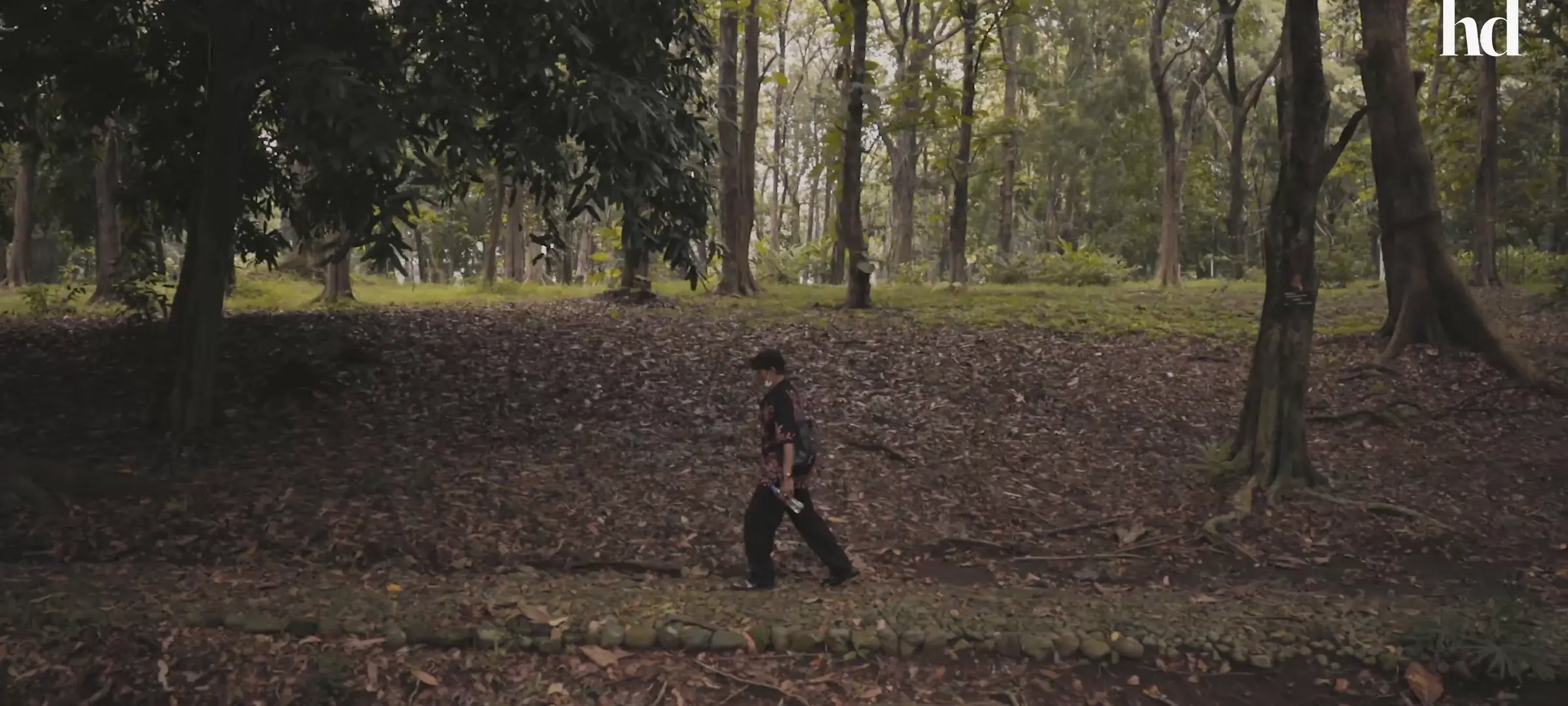
What the German files describe in the dry language of the diplomatic cable, the survivors describe in their own words. For our documentary we interviewed them in Indonesia, more than half a century after the events.
In their own words
WarningThese testimonies describe torture, rape and killing. The subtitles are the film’s own; the transcripts follow them.
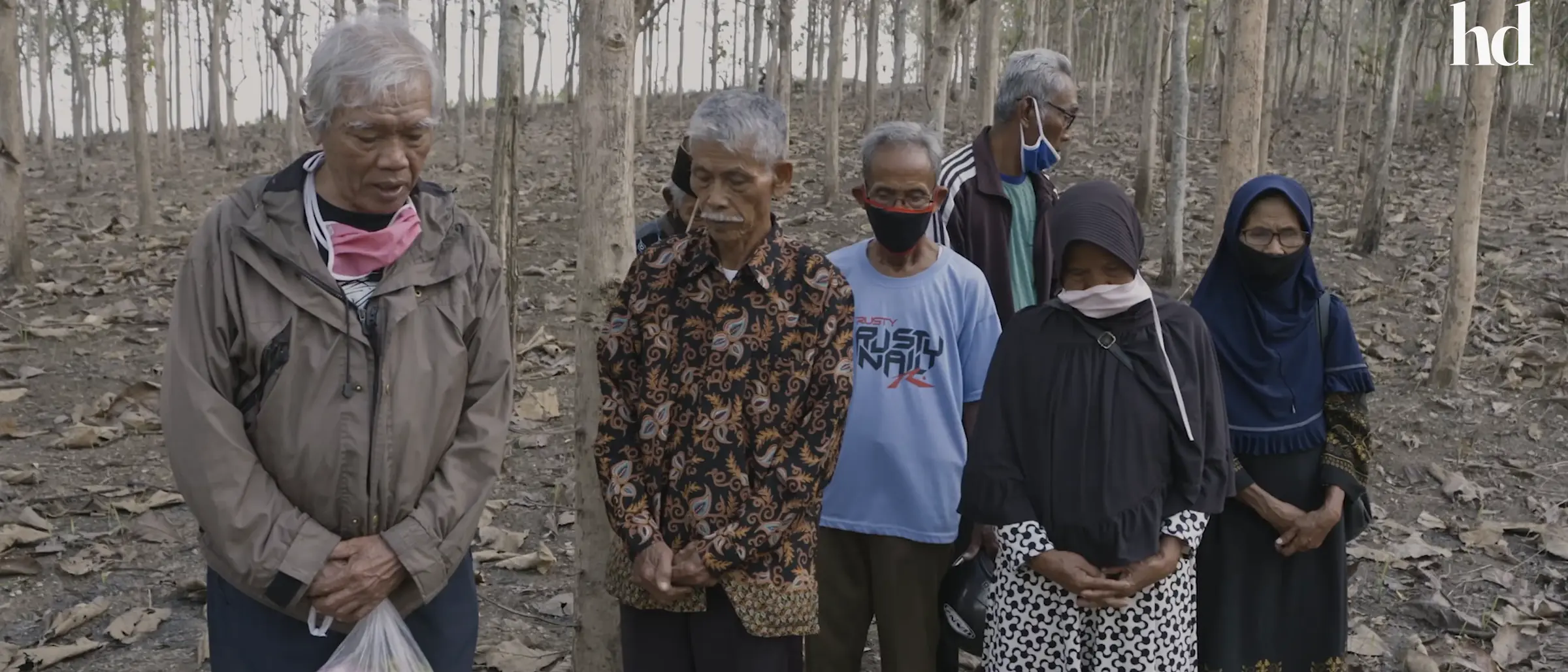
One of them returned with us to the mass grave where his family met its end: “Early that morning, we entered through this water tunnel to find that my family, my uncles, my father’s older and younger brothers, had all been taken… It turned out they had become corpses. Here, in this burial ground. There we saw blood, bodies, legs, heads. Some had already been cut apart. There were a lot of them.”61
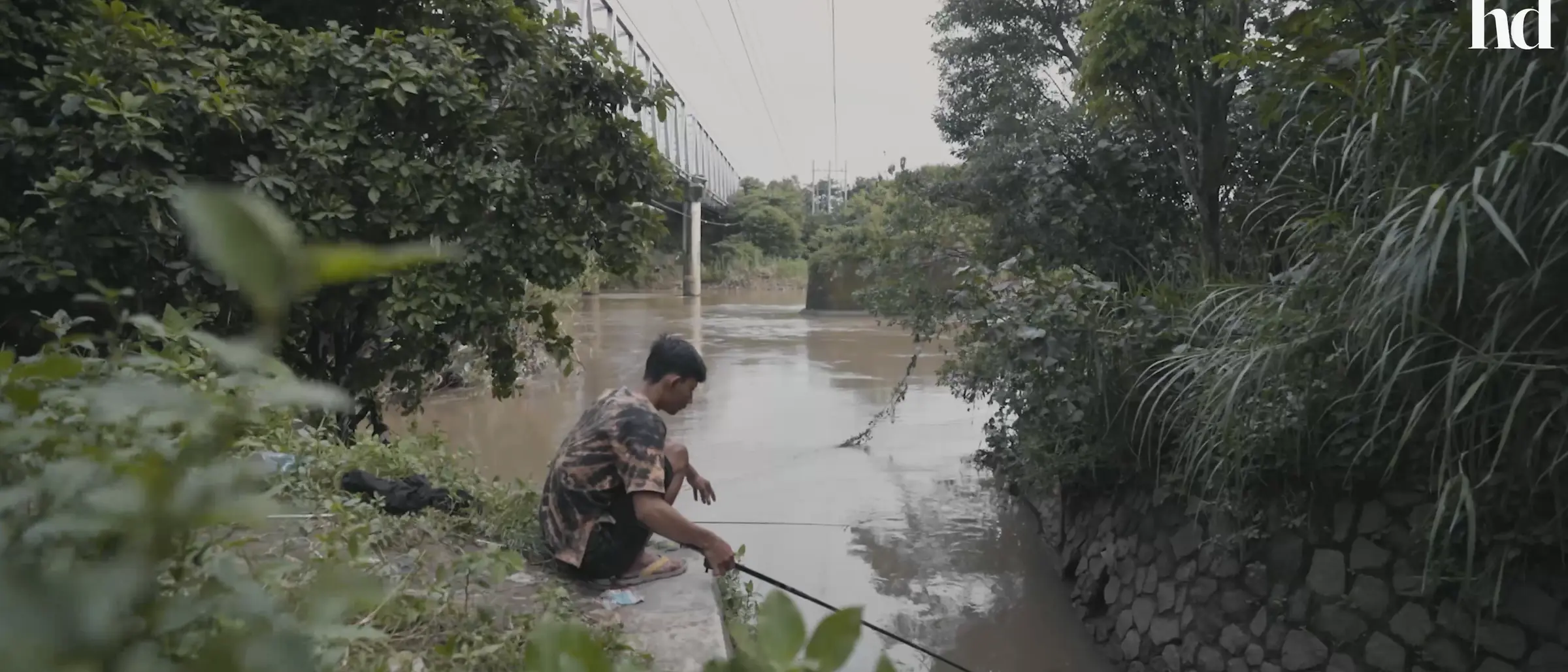
Bedjo Untung was a schoolboy from Pemalang in Central Java. His father was taken away in early October 1965 and never came back. He himself was caught five years later: “I had to take off my clothes and trousers. The end of my index finger was tied to a wire connected to electricity. I was electrocuted and beaten several times.” What he witnessed in detention he summarised in one sentence: “They were given electric shocks, beaten, hanged, then cut into pieces with razors. Some were even beheaded.”62
The violence was also sexual, and it did not spare children. One woman told us what happened when a squad came for her father: “They tied my mother’s hands and she was taken to the bedroom. Meanwhile, they held me down and gripped me. I was raped by five men. Imagine, I was only 14 and five men did that to me. I couldn’t breathe and I even thought I was going to die.” Another woman, Mrs. Saenah, was a young woman in 1965 when the men came night after night for her father and her brother. The accusation, as always, was membership in the PKI: “I was raped. In that office… I was… three times, I know. They took turns! Oh God, I… God, I was crying… I was probably unconscious…”63
Others were forced to service the machinery of death. Martono, a welder, was seized by the para-commando regiment RPKAD in November 1965, beaten and nearly scalded, and then put to work: “When they electrocuted people to death and as time went by, they told me to take care of it. Every time they had a lot of bodies, they would call me: ‘Martono!’ Then I had to take them. I would drag away the bodies. I was actually a prisoner. I had no choice, I was forced to. If I had refused, I would be dead by now.” Another man had to throw the corpses into the river: “We threw bodies here into the river. At the time, they would just roll down. What I remember is that every time I threw the corpses, I said a prayer: ‘Oh Lord, these are your beings.’”64
The arbitrariness of the terror is captured in a single detail from another interview. The speaker’s uncle was suspected of belonging to the BTI, the PKI’s peasants’ front, “because they found a hat in his house, a farmer’s hat with the letters ‘BTI’. So he was executed too.” That was the whole evidence. In the botanical gardens, the same witness recalled, the victims were beheaded with swords: “They were mutilated, hacked and slaughtered.”65
The perpetrators confirmed all of it, without remorse. One militiaman described how he armed himself: “The idea was Jihad. So I thought, I will search for a weapon. I went to the market, looking for iron. It was made into an admirable axe. Sharp.” He became known as Burhan Kampak, Burhan the Axe. Then the state took him in hand: “Then, we coordinated with the Armed Forces. They trained us, students and young people, to be more skilful.” And immediately after that, without being asked, he settles the question of who was attacking whom: “We did not retaliate, no, but we had to kill them.” There was nothing to retaliate against. They killed anyway.
The rest of what the perpetrators told us has the same flatness. On the length of the job: “It was unbelievable back then, from 1965 to 1968. Everywhere else it was all over. Here it took three years, the cleansing.” Asked how many people he had killed: “Well, I don’t remember. Anyway, if I met them, it was you die or I die. That’s all.” Asked whether there had been any trial: “Well, no, there was no need for a court, we were at war. The situation was a war. So there was no court. It was a war, brother.” And asked whether there was no remorse at all: “Remorse? … Oh no… I was excited! I have no remorse, because they were our enemies.”66
Those who survived the massacres disappeared into the camps. Bedjo Untung was one of them. In Salemba prison in Jakarta he was held in a block so packed “that even the toilets were used as detention rooms”, where prisoners caught and ate sewer rats because food was so scarce. He was arrested in 1970 and released in 1979: nine years of detention without any kind of legal process.67 In total, between 800,000 and three million Indonesians were killed, and hundreds of thousands more were maimed, raped or imprisoned for years, some of them for decades.
The killing they describe stands in the files of the Federal Government in its bureaucratic language: “inhuman cruelty”, “short shrift”, “murder wave”, “horrific bloodbath”, “completely exterminated”.
What Germany knew
Bonn was told week after week, from the first weeks of the killing into 1966, how many had died, in which province, and when. The chain does not break anywhere: the test arrests and rumoured burials reported in January 1965, the officers announcing in June that they were waiting for their moment, the leaflets of October calling for a holy war, the tallies of December, the secret figure of almost 800,000 in February 1966.
On 25 October 1965 the attaché Meyer reported that the armed forces had opened the campaign against the PKI through the Muslim party and its followers, “though with the benevolent encouragement of the armed forces”. Allegedly discovered PKI documents, he added, had supplied the grounds for intensifying and continuing the measures.68 On 29 October a telex with wide distribution in Bonn passed on the account of the dpa correspondent, cabled under the cover name “the well-known informant”, which Werz forwarded “without comment of his own”. It relayed, unverified, reports of communist killings and arson, at least 150 dead in East and Central Java and 21 in Balikpapan, and called what followed “white counter-terror”: at least 500 communists killed by crowds in North Sumatra, and on the island of Madura, off East Java, “no active communist is left alive”. Paratroopers were apparently giving prisoners “short shrift”, and rebel groups had been driven into barren country “to literally starve them out there”. The BND saw the same. Its report of 3 November 1965, filed under the subject “Föhrenwald”, speaks of “a veritable slaughter of communists” in Central and East Java, “first and foremost by fanatical Muslims”, and states that the many anti-communist actions were “of course carefully prepared by the army leadership”.69
On 29 November 1965, Ambassador Werz passed the following information on to Bonn: “According to confidential information from the army, on 21 November the PKI leader Aidit was taken prisoner by the army near Solo [Surakarta] in Central Java and shot the next day.”70 Dipa Nusantara Aidit was the chairman of the PKI. Werz opened his report of 14 December 1965, headed “Losses of the Indonesian Population since 1 October of this Year”, with this: “The battle of the army and the Muslims against the communists is being waged outside Jakarta with dogged severity and in part with inhuman cruelty.” The state news agency Antara, he wrote, published daily reports of the capture and killing of communists who, it said, had resisted, but its figures, on the information the embassy had so far, “fall far short of reality. The true casualty figures exceed the official ones many times over.” His own figures, from witnesses in the provinces, confidential Indonesian reports and friendly missions, were in his words probably too low, and further heavy losses were to be expected. Then the table: East Java approx. 50,000 dead, mostly communists; Central Java approx. 40,000, communists and non-communists; West Java including Jakarta approx. 10,000, by far predominantly communists; North Sumatra approx. 20,000, by far predominantly communists; Aceh approx. 3,000, exclusively communists; Madura approx. 2,000, exclusively communists; Bali approx. 3,000, predominantly communists.71 Added up: some 128,000 dead by mid-December 1965.
The embassy’s count, province by province
Report 1518/65, “Losses of the Indonesian population since 1 October”. Werz wrote that his own figures were probably too low.
Source: embassy report no. 1518/65, Djakarta, 14 December 1965, restricted. PA AA, B 37 REF. IB5, vol. 170, scans B-08–B-10 · · note 71
There is no basis in this report for any subsequent claim that Bonn failed to understand the nature of the violence. Werz noted on Madura and in Aceh that fanatical Muslims had made short work of a communist presence that was never very strong to begin with. The military governor of Aceh, at the northern tip of Sumatra, informed the provincial parliament that the PKI ban in his domain was of only theoretical import, “as a result of the physical extinction of the communists there”.72
In North Sumatra, according to reliable reports, some 2,000 were being killed each week, almost all of them communists. The embassy recorded the methodical way it was done: “In a virtually stereotyped procedure the army loads people suspected of being communists onto trucks during raids, and the trucks are stopped some distance away by an agitated crowd. After a few symbolic warning shots by the army the prisoners are then handed over to the population and killed by it.”
Then there is Java. The American embassy put the dead there at 100,000, a figure the German embassy found to be in accord with its independent information. On Bali the “murder wave” had been running only about two weeks. A first wave of excesses in mid-November had set fire to numerous communists’ houses; then, around 1 December, the army moved six tanks across from Probolinggo in East Java, and these, meeting resistance, “caused a horrific bloodbath” in the provincial town of Negara. A local Balinese newspaper reported that 1,506 people had lost their lives in Negara alone. The comparatively low figures for West Java the embassy put down to the moderating efforts of the military governor in Bandung, Major General Ibrahim Adjie, the same Adjie whose test arrests the German attaché had reported eleven months earlier. Adjie now said he feared worse from the fanaticised Muslims than from the communists.
Then, at the end of the report, one line about the living. No precise information could yet be obtained on the number held in prisons and camps, Werz wrote, but the newspapers were filling with complaints that nobody knew any longer where the constantly growing stream of those arrested was to be housed. It was likely, he added, to run to several hundred thousand.73 Days later, the embassy reported that in Medan, the largest city on Sumatra, around sixty Chinese had been murdered “with the tacit toleration of the army”.74 None of this was hidden from Bonn; it is all in the files.
On 17 December 1965 the State Secretary’s office recorded the assessment of the embassy’s political officer. General Sukendro had presented the official casualty figures during his visit to Bonn; these, the note states drily, “are however incorrect”. An Indonesian source put the killed in East Java alone at 14,000 and in North Sumatra so far at 15,000 to 20,000, “and exclusively communists”. In Aceh and Madura the Communist Party had been “completely exterminated”, with 3,000 dead in Aceh. Of the 2,000 members of the communist youth organisation who, the note says flatly, had been substantially involved in the abduction and murder of the six generals, “hardly one is still alive”. The military tribunal, the note continues, “will have difficulty finding enough defendants to put on trial.” Then comes the sentence that sums up what Bonn knew:
“The murdering continues in silence, but with unbelievable doggedness and cruelty.”75
On 21 February 1966 the embassy cabled to Bonn, classified secret, what it had been told about the findings of Sukarno’s own fact-finding commission:
“While Sukarno claimed the number of those killed after the putsch was 87,500, the commission in reality established that it amounts to almost 800,000. Above all on Sumatra and Bali, bloodshed of monstrous proportions has taken place. On Bali, whole villages were killed off, since insult to the Hindu religion was in each case punished by the killing of the entire clan.”76
A figure of almost 800,000 dead was on file in the Foreign Office in February 1966, stamped secret. On the next page the ambassador passes on a still higher figure: “From another quarter too I hear that the number killed is far higher than Sukarno admits. A member of the Indonesian intelligence service in Surabaya puts it at one and a half million.” The weapons approvals of 1966 and 1968 described above all came afterwards. Yet in 2014 the German government told the Bundestag it had “no precise information” on the number of victims.77 The government’s own files say otherwise.
The death toll on file in Bonn
Every figure below reached the Foreign Office between December 1965 and February 1966. The weapons approvals of 1966 and 1968 all came afterwards.
Sources: report 1518/65 (), secret telex no. 59 of 21 February 1966 (), Bundestag printed paper 18/1554 (). The grey bar is Sukarno’s public figure, not the embassy’s.
Nazis for Jakarta
Seven men led the mission between 1952 and 1970, and six of them had been Nazi party members or Nazi propagandists: five were members of the NSDAP, the Nazi party, and the sixth had made Nazi propaganda for East Asia. Each of the six who followed the first ambassador, Werner Otto von Hentig, had built his career in the foreign service between 1933 and 1945. They served under Joachim von Ribbentrop, Hitler’s foreign minister.
The party numbers are on the record. Dietrich von Mirbach, ambassador from 1959 to 1963, joined on 1 May 1933 with the number 2,781,465 and served in the SA, the Nazi party’s stormtroopers, until 1935; according to the East German Braunbuch (“Brown Book”), of which more below, he was personal aide during the war to State Secretary Gustav Adolf Steengracht von Moyland, who was convicted at Nuremberg in the Wilhelmstraße trial of senior Reich officials. Gerhart Weiz, 1963 to 1964, was in the SA from 1933 and in the party from 1937. According to the Braunbuch, he had also applied to join the SS and, in 1934, to serve in the Gestapo. Luitpold Werz, 1964 to 1966, joined on 1 October 1934 with the number 2,873,248, and in the last months of the war headed Referat Inland II B in the Foreign Office’s Inland II group, the branch that dealt with Heinrich Himmler’s SS and police apparatus. Kurt Luedde-Neurath, ambassador from 1966 to 1968 and therefore in office while the killing went on, joined on 1 May 1937 with the number 4,745,122 and had been in the SA from 1933 to 1939. Helmut Allardt, 1954 to 1958, applied in March 1939 and was admitted that August with the number 7,055,168. Hilmar Bassler, the last of them, from 1968 to 1970, was, according to the Braunbuch, responsible during the war for Nazi propaganda in East Asia in the press department of the Foreign Office and a trusted contact of the Gestapo and the SD, the SS intelligence service. No party membership has been documented for him.78
One man does not belong on the list. No party membership has been documented for Werner Otto von Hentig, the Federal Republic’s first ambassador to Indonesia in 1952. He was a critic of the regime who stayed in the service and used it. As liaison officer to the 11th Army in Ukraine in 1941 and 1942 he protested repeatedly against the massacres of Einsatzgruppe D, the SS unit that murdered tens of thousands of Jews in southern Ukraine and Crimea, calling them murder. Bonn had a man like that on its books. For the sixteen years that followed it sent the others.79
Seven ambassadors: five party members and a Nazi propagandist
The Federal Republic’s heads of mission in Jakarta, 1952–1970, with the records given in the article.
Membership numbers from the Nazi party’s membership card files in the Federal Archives and the East German Brown Book; no number has been published for Weiz, and no party membership has been documented for Bassler (note 78). On Werz, the Foreign Office’s own file: . Von Hentig’s papers: .
So Bonn staffed its mission in the largest Muslim country on earth with men who had the relevant experience. According to the Braunbuch, Bassler had spent the war producing German propaganda for East Asia and then ran the East Asia desk in Bonn before being posted to Jakarta himself. He was there by the time the killing had moved from the villages to the courts. In November 1968, now in charge of the embassy, he reported on the protest of East German lawyers against the execution of three communist leaders, Njono, Sudisman and Wirjomartono, and summed up: the Federal Republic “can only be grateful to the ‘democratic lawyers’ from Pankow for this excellent propaganda against the Soviet Zone among the public here”.80 Pankow was the East Berlin district where the GDR leadership lived. These were not passive careerists with an awkward past. Werz, an NSDAP member, reported the death tolls, hoped that the army, which was “systematically clearing out the communists”, would prevail81 and called the massacre “a cleansing entirely in our interest”. In October 1965 Bassler recorded that the Federal Press Office and Deutsche Welle had been asked to push the atrocity propaganda, and wanted the big newspapers prompted as well. Three years later the Federal Republic made him its ambassador in Jakarta.
When the embassy wrote of an “Endlösung”, or its political officer reported that the Communist Party had been “completely exterminated”, these were not careless words. The ambassador who put his name to the “Endlösung” reports had served the state that gave those words their meaning.
This continuity was not questioned; it was defended in writing, in a Foreign Office file. In June 1965, the Indonesian embassy in Bonn put forward word from Jakarta that Sukarno and others were hearing rumours about Ambassador Werz’s Nazi background. The file concedes what is true: Werz was a member of the NSDAP from 1934 and worked for the Nazi-era Foreign Office until 1945, with a stint in the Abteilung Inland in February and March of that last year, though the document makes little of it. Yet the senior official who received the Indonesian envoy told him that Werz’s past was, in his view, “impeccable”, blamed the rumours on the “well-poisoners from Pankow” and promised material to counter them; his record of the talk went to the State Secretary. A week later a Foreign Office paper on Werz’s record called him an “irreproachable official” and declared that the attacks on him rested on “unproven insinuations” and “pure calumny”.82 This is the same ambassador who, a few months down the line, would three times put his name to Sukarno’s promised “political final solution” and count the dead in six figures.
Bonn called the charges calumny; in East Berlin they were in print. Within weeks the GDR published its Braunbuch, a catalogue of ex-Nazis in office in the Federal Republic drawn up by the state archive from captured records. It came from an interested party, but Bonn’s own file from those same weeks admitted what it said. The 1968 edition lists five of the Jakarta ambassadors: Werz, Mirbach, Weiz, Luedde-Neurath and Bassler.83
Then there was the BND. The Federal Intelligence Service, too, had its old SS man in Jakarta. Reinhard Gehlen, who had headed Hitler’s army intelligence on the Eastern Front, built and ran it with his old comrades from the war. In his memoirs of 1971 Gehlen declared that the success of the Indonesian army, which “pursued the elimination of the entire Communist Party with consistency and severity”, could not be rated highly enough. In the same passage he boasted that his service had been “in the fortunate position” of briefing the Federal Government “from excellent sources” on the decisive days in Indonesia, just as it had pointed early to the mounting crisis. Among his men in Indonesia was Rudolf Oebsger-Röder, a Nazi party member since 1931 and later an SS-Obersturmbannführer. In the autumn of 1939 he led an SD commando in occupied Bromberg, in Poland, and in the spring of 1944, as Hungary’s Jews were being ghettoised and deported, he commanded the Security Police and SD in Cluj. After the war he joined the Gehlen Organisation, the spy network built under American supervision from which the BND emerged in 1956. By the government’s own account to the Bundestag in 2023, he worked in Indonesia for Gehlen’s service from December 1959 to December 1962 and again from July 1964 to March 1966, through the coup and the height of the massacres. His cover was journalism. Under the name O. G. Roeder he later wrote the biography of General Suharto, The Smiling General. The BND’s own files, published by its in-house historian in 2011, add what the government left out. In July 1964 the service had dismissed him, on its president’s orders, “because of his Nazi record”, and then kept him on anyway, “as a source in Indonesia”, until 31 March 1966. He was, the same file notes, “known to friend and foe as a BND man”. By his own account, the Indonesian intelligence service approached him to plant its official line in the press. Nor was he alone. In 2023 the government said it could not establish the exact number, but that the files it had checked by hand so far showed three people who had worked for the BND in Indonesia between 1965 and 1968; their task, it said, was gathering information.84 An SS veteran gathered intelligence for Bonn while the killing ran its course, then wrote the life of the man who ordered it.
“Shoulder to shoulder”: Bonn, Washington and the winners
When US President Lyndon B. Johnson and Chancellor Ludwig Erhard met in Washington on 27 September 1966, it was Johnson who raised Indonesia. Johnson stated that communism had suffered a great loss during their time in office which had not been sufficiently exploited: Indonesia, where communism had lost “a nation of a hundred million”. He hoped, he said, that the Chancellor could support the current leaders in Indonesia with German industrialists and with government aid, and that such cooperation would show the Germans standing “shoulder to shoulder” with the Americans in aid to the Third World. Indonesia had been a great victory for the free world, he added, one that had not received the attention due to it, though it should not be trumpeted too loudly, because the victory was not yet quite certain. Erhard replied that the German position had naturally shifted “since Sukarno is no longer the all-powerful leader”, but that he believed “the ground had now been prepared for greater activity”.85
In practice, such talk meant the annihilation of the communists and those in their orbit, from 1965 into the early 1970s. Germany knew it. The enterprise was underwritten by German credits, carried by German propaganda and supplied with rifles, ammunition and powder cleared in Bonn, while officials put their approval in writing: keine Bedenken.
Wardaya puts the difference in a few sentences: “Then, there were the Nuremberg trials. That could happen, because in Germany’s case, the perpetrators lost the war. Indonesia in 1965 was different. The perpetrators won, so they took power.”86 Until Suharto fell in 1998, the memory of the massacre was silenced and the survivors lived in fear of speaking out. Most of the killers are still celebrated as heroes. The winners had their friends in Bonn.
Berlin has been asked. In 2014 the government told parliament that it no longer held any data on arms, money or goods supplied to the Indonesian military, government and intelligence services between 1964 and 1970, and that it and the BND had, “according to current knowledge”, supported the killings “neither directly nor indirectly”. The approvals quoted in this article sit in the Foreign Office’s own archive, open to anyone who asks. The government had said as much itself: an analysis of Bonn’s reaction at the time, it told the Bundestag, was a matter for historians, and “the relevant files in the Political Archive of the Federal Foreign Office are accessible in accordance with the statutory provisions”.
Asked what contacts Bonn had kept with Indonesia’s government during the massacres, it named a single visit, General Sukendro’s in November 1965, and said nothing of the support Carstens had promised him. Three of its nineteen answers, and the part of a fourth that concerned the BND, it would not give in public: what it knew of foreign support for the massacres, which German federal staff had been in Indonesia to train or advise, and whether the BND had run a “legal residency” inside the embassy in Jakarta. It classified them and lodged them with the Bundestag’s secrecy office. For keeping secret which German staff had trained or advised in Indonesia, it gave one reason: the confidentiality of “cooperation between intelligence services”. It had found no evidence of BND support, it said, “in the files of the Federal Intelligence Service indexed so far”. In 2020, after the BND files on the DM 1.2 million request came to light, it called the “supposition” that the BND had supported Indonesian intelligence and the military’s special units and militias “in the course of the mass murder” with money, advice and equipment “not accurate”, and classified the rest of its answer as secret. André Hahn, the Left Party MP who had asked, read the secret part and said: “The concrete figures it contains on support actually given to the regime are evidently not meant to become known.” In 2023, asked again, it found no sign of any “purposeful entanglement” of German governments with those responsible, commissioned no research, and declared that it did not share “the hypothesis of support”. No apology, no historians’ commission, no reparations.
The same answer of 2014 records that 122 Indonesian soldiers were trained by the Bundeswehr between 1960 and 1998, and that in 1981 a young captain named Prabowo Subianto trained with the border guard’s counter-terror unit GSG 9. Suharto’s former son-in-law is today Indonesia’s president. In November 2025 he declared Suharto a national hero. And sixty years on, as it backs Israel’s war on Gaza, Berlin still speaks of “historical responsibility”.87
Investigation by Hüseyin Dogru, a journalist and award-winning documentary producer.
This work would not exist without Emrah Cilasun. The researcher and author spent weeks in the archives and was part of every step, from research to analysis to evaluation.